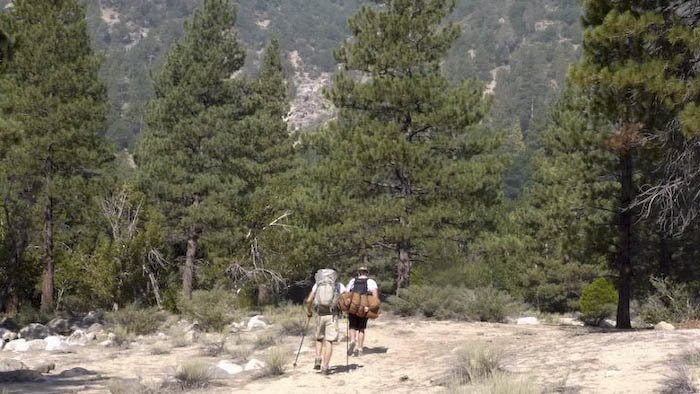
Pack Weight and Down Sizing

This week I was talking to Campfire Chic about pack weights and size, specifically about how some people carry quite a bit of gear for their over nighter and multi-day trips.

Everyone has a different way of backpacking – some of us are minimalist and some of us are luxury campers.  Most of my friends are heavy haulers, refusing to give up their 80 liter packs and 50-60 lb carry weight.  We get a lot of comments and questions about how we are able to pack several days worth of food and supplies in our small packs, and still have all our necessary gear.  The answer is simple, pack lighter and pack less.

294144_10100477426959401_4464083_n

Carrying everything inside the pack (left) versus carrying it all outside (right). My pack (left) was approximately 25 pounds on this trip.

Continue reading

Gear Review – REI Ultra Dog Pack

Quick and Dirty
Gear Type: Dog Pack
Material: Rip Stop Nylon
Trail weight: 18 ozs (small)
Price: $75, on sale for $25
Link:  REI Ultra Dog Pack
Pros: Light, large storage pockets, well balanced and won’t slide off the dog, somewhat water proof.
Cons: Price, weight distribution is important for proper fit, minor chaffing, straps will drag if not tied properly, belly pads move around a lot.

Dakota


Continue reading

How to take care of your gear post backpacking trip

After coming home from a multi-day backpacking trip, sometimes the last thing we want to do is unpack and cleanup our gear. The only thing that gets us going is knowing we can prolong the usage of our camping equipment by taking good care of it. Here’s a few tips we’ve learned from our trips to help extend the lifetime of your camping equipment.

  1. Pull your sleeping bag out of the compression sack to air out. Store the sleeping bag in a storage sack (they are much larger than the compression sack). Sleeping bags will deform if you leave it compressed in your stuff sack and the filling material will be displaced, leaving it lumpy.
  2. Before you unpack the tent for the hike back, make sure to tip the tent upside down to clean out any debris left inside the tent. This is an important step for us because Dakota usually pulls in a lot more dirt with her paws. Once home, make sure to pull out the tent to air out, it can be miserable sleeping in a stinky tent next time around.
  3. If you have a camel pack for water storage, make sure to empty out any remaining water from the sack. We disinfect the camel pack every couple of months with a couple drops of chlorine beach mixed with tap water. Tip the water sack upside down, using gravity, rinse out the hoses and mouth piece with the water bleach mixture. To avoid mold buildup, disconnect the hose and hang the pack outside to dry.
  4. Backwash and sterilize the water purifier. This does not need to be done after every backpacking trip, however, backwashing the water purifier is important to clean out the filter cartridge. We have a First Need XL water purifer but every filter is different and the filtration volume per cartridge filter varies. One easy way to tell when your cartridge filter is dirty is the amount of effort you are putting into pumping water. If there is a lot of resistance during pumping or only small amounts of water is being treated through the filter, it is a good indication the filter needs to be backwashed.

Emigrant Wilderness, Stanislaus National Forest, California

The Quick and Dirty:
Location – Stanislaus National Forest
Distance – Varies, 10 miles to Gem Lake
Terrain Type – Flat terrain, Switchbacks, Stairs.
Difficulty – Intermediate to Strenuous
Best Time – Summer through Fall
Special Conditions – High water in creeks, mosquitoes in early summer, popular

Emigrant Wilderness

Continue reading

Affordable 3 Day Backpacking Food Preparation

Louis and I take eating pretty seriously, we love a good meal. When it comes to backpacking, we’ve always had trouble finding the right food. The ideal meal for us are light, affordable and tasty meals. We started out with Mountain House freeze dried food and were pretty happy with the taste, however, at $7-$9 per bag, it was a too expensive for us. For our upcoming three day backpacking trip, I decided to try something different. I decided to dehydrating fresh produce and scavenge through Walmart for cheaper ready made packaging food.

Dehydrating Fresh Produce 

Two nights before we set out for our backpacking trip, I looked through our fridge and pulled out fresh produce that’s likely to spoil during our absence and came up with two green bell peppers, two ears of corn, several Roma tomatoes and a handful of strawberries. After chopping the produce into small pieces, I preheated the oven on the lowest temperature possible, in our case, it was 170 degrees. I laid the fresh produce on a flat sheet and left it in the oven for 6 hours. Depending on the oven, more or less time may be needed to dehydrate fresh produce.

Here’s a daily breakdown of what I packed for both of us:

Friday Night:and Saturday Morning 

To get a head start Saturday morning, we decided to drive to the campsite Friday night and camp at the trail head. With our campsite Friday night so close to our car, we packed fresh fruits, bagels, two boil eggs and Thursday night’s leftover dinner for food.

Sunday and Monday Breakfast:

  • Oatmeal with dried cranberries, dried milk, 1Tbs of sugar and oven dried strawberries at 1 dollar for two days if you buy everything in bulk.
  • Hot chocolate and tea at $0.50 for two days if you buy everything in bulk

Saturday through Monday lunch:

  • PB&J sandwiches and tuna sandwiches. I found dollar pack aluminum packets of tuna at Walmart and decided to give it a try. Total for lunch is approximately 3 dollars.
  • Dried fruits and nuts trail mix at $2 if you buy everything in bulk

Saturday Night Dinner:

  • Two packs of instant Knorr Rice at one dollar each. At 270 calories for 2.5 servings per packet and 29% sodium, this is about the same nutritional value as the Mountain House Spaghetti with Meat Sauce. The only thing lacking from the Knorr Rice dish is protein, there was only 6 grams of protein compared to 11 grams per serving for the Mountain House. We figured our beef jerky and tuna would compensate on the lack of protein. The rice meals does take a little longer to cook, we found they taste the best being cooked on an open flame for 7-10 minutes because dousing it with boil water cooks it unevenly.
  • One pack of Idahoan Loaded Baked Mash Potatoes at one dollar per pack. These mash potatoes are delicious and super easy to make. All you need to do is dump 2 cups of boiling water into serving bowl and let it stand for a couple minutes.

Sunday night dinner:

  • Two packs of instant ramen noodles with oven dried corn, bell peppers and beef jerky at less than a dollar for a pack of ramen noodles
  • One pack of Idahoan Loaded Baked Mash Potatoes at one dollar per pack.

In the end the total cost of food for a 3 day backpacking trip between Louis and I cost less than 15 dollars since we utilized our leftovers.